Articles
-
Orange Shirt Day & National Day for Truth and Reconciliation (September 30)
September 30th is Orange Shirt Day and National Day for Truth and Reconciliation. Read on to learn about these days, local events, and how to learn more.
About
 Orange Shirt Day
The Orange Shirt Day movement was started by Phyllis Jack Webstad, a member of Stswecem'c Xgat'tem First Nation and Survivor of the residential school system (also called residential institutions).
When Phllis was six years old and preparing to attend a residential institution, her grandmother bought her a new orange shirt. When she arrived, the shirt was taken from her. This experience became a symbol of the loss, mistreatment, andContinue reading
September 30th is Orange Shirt Day and National Day for Truth and Reconciliation. Read on to learn about these days, local events, and how to learn more.
About
Orange Shirt DayThe Orange Shirt Day movement was started by Phyllis Jack Webstad, a member of Stswecem'c Xgat'tem First Nation and Survivor of the residential school system (also called residential institutions).
When Phllis was six years old and preparing to attend a residential institution, her grandmother bought her a new orange shirt. When she arrived, the shirt was taken from her. This experience became a symbol of the loss, mistreatment, and lasting harm experienced by Indigenous children who were forced to attend residential institutions.
Today, Orange Shirt Day is an Indigenous-led day of remembrance, reflection, and learning. It honours Survivors, the children who never returned home, and the families and communities affected by the residential school system. September 30 was chosen because it marks the time of year when many Indigenous children were taken from their families and communities and sent to residential institutions.
Learn more about Orange Shirt Day through the Orange Shirt Society or by reading Phyllis's Orange Shirt.

About National Day for Truth and Reconciliation
National Day for Truth and Reconciliation became a federal statutory holiday in 2021 following a Call to Action from the Truth and Reconciliation Commission of Canada.
It is a day to learn about the truth about Canada's history, including the harms caused by residential institutions and other colonial policies. It is also a reminder that reconciliation is an ongoign responsibility. Through learning, relationship building, and meaningful action, each of us has a role to play in supporting healing, jusitce, and reconciliation.
Learn more about the National Day for Truth and Reconciliation Day on the Government of Canada website.
Note: As part of learning 'truth', events and learning resources listed below may include discussions about residential institutions, colonization, racism, violence, loss, and intergenerational trauma. Please use discretion and take care of your wellbeing and access support if needed. Support resources are listed below.
Supports
You are not alone. Support is available.
If learning about residential institutions and the impacts of colonization bring up difficult emotions, consider reaching out to family, friends, Elders, community supports, or professional services. The following resources are available 24 hours a day:
Hope for Wellness Help Line offers immediate help 24/7 to all Indigenous Peoples in Canada. 1-855-242-3310 (toll free) or online chat www.hopeforwellness.ca
National Residential School Crisis Line provides 24/7 crisis support to former Residential School students and their families. 1-866-925-4419 (toll free)
Chatham-Kent Victim’s Services support local residents after traumatic experiences, but is not a mental health crisis service (call 911 in case of emergency). 519-436-6630 – leave a voicemail with name, reason for calling, call-back number.
Local Events
Events and descriptions will be updated as more information becomes available. To add an event, contact DEIJ@chatham-kent.ca
Note: Events may include discussions about residential institutions, colonization, racism, violence, loss, and intergenerational trauma. Please take care of your wellbeing and access support if needed. Support resources are listed above.
Wear orange and join events below to listen, learn, reflect, and consider how each of us can support healing, justice, and reconciliation in our communities.
All events are free and open to everyone, unless otherwise noted.
Sunday, September 27, 2026, 2:00 p.m. - 4:00 p.m.
Paint with Moses
Spirit and Life Centre, Chatham
Open to ages 12 and up. Register before September 21.
Join the Truth and Reconciliation Action Table of the Chatham Catholic Family of Parishes for an educational workshop with First Nations artist Moses Lunham. This meaningful event offers an opportunity to learn more about the 94 Calls to Action, deepen understanding of Indigenous experiences, and reflect on our shared responsibility toward Truth and Reconciliation.
 Monday, September 28, 2026, 12:00 p.m.
Survivor's Flag Raising & Information Booths
Chatham Civic Centre, 315 King Street West, Chatham
Partnership with Maawnjidimi Indigenous Network, Ska:Na Family Learning Centre, 7 Generations Indigenous Cultural Friendship Centre, and the Municipality of Chatham-Kent.
 Monday, September 28, 2026, 12:30 p.m. - 2:00 p.m.
Meet & Greet and Networking
Deshkan Ziibi, 495 King Street West, Chatham
Following the flag raising, join Maawnjidimi Indigenous Network, Ska:Na Family Learning Centre, 7 Generations Indigenous Cultural Friendship Centre, and partners for refreshments and networking.
Wednesday, September 30, 2026, 10:00 a.m.
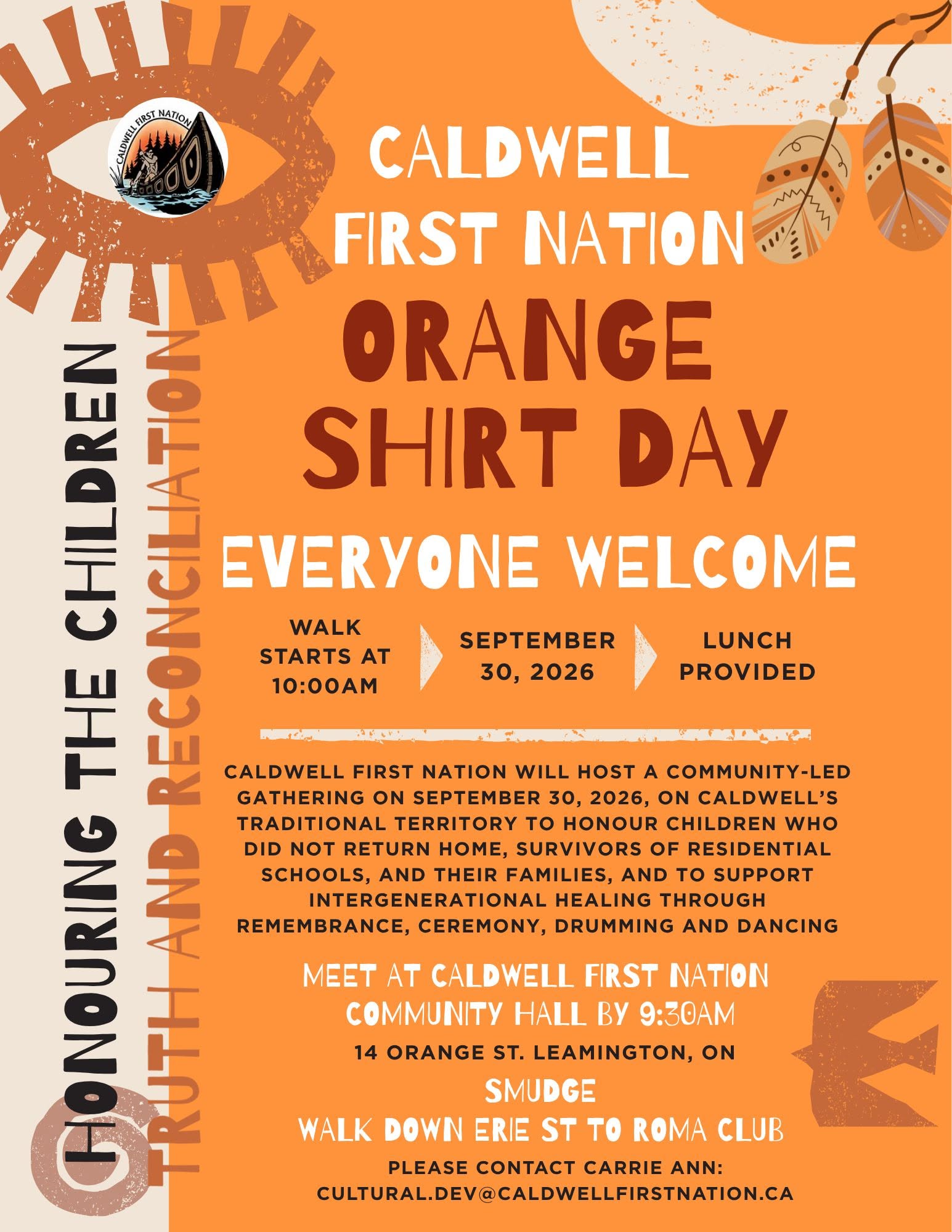
Caldwell First Nation Orange Shirt Day
Caldwell First Nation Community Hall, 14 Orange Street, Leamington
Caldwell First Nation is hosting a community-led gathering on Caldwell's Traditional Territory to honour children who did not return home, Survivor's or residential schools, and their families, and support intergenerational healing through remembrance, ceremony, drumming and dancing. Meet at the Community Hall by 9:30. Smudge, walk down Erie Street to Roma Club. Everyone welcome. Contact Carrrie Ann cultural.dev@caldwellfirstnation.ca for more information.
Wednesday, September 30
 , 2026, 10:30 a.m. - 12:00 p.m.
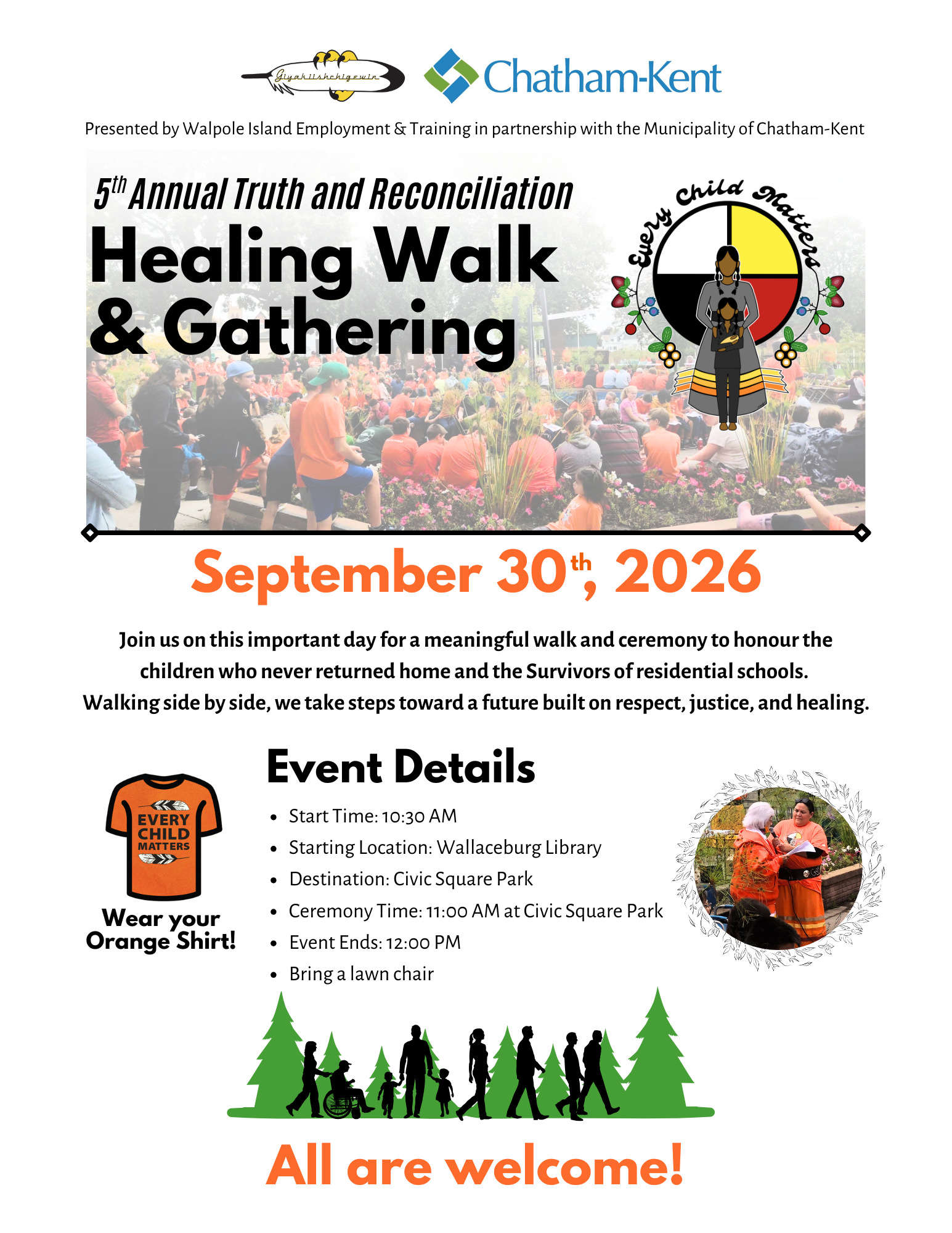
5th annual Healing Walk & Gathering
Wallaceburg
Join a meaningful walk and gathering to honour local Survivors of residential institutions. Walk begins at Wallaceburg Library and ends at Civic Square Park for the gathering. Please feel free to bring lawn chairs. Partnership between Giyakiishchigewin, Walpole Island Employment & Training and the Municipality of Chatham-Kent.
Wednesday, September 30, 2026, 11:00 a.m. - 1:00 p.m.
Orange Shirt Day Activities and Walk of Reconciliation
St. Clair College Chatham Campus - 1001 Grand Ave W
Come together to honour Survivors of the residential school system, their families, and to remember those who did not return. The event will foster dialogue and learning about Canada's colonial history and how it continues to impact Indigenous communities today. 11:00 a.m. flag raising. 11:00 a.m. - 2:00 p.m. National Centre for Truth and Reconciliation live stream Room W1028. Orange Shirt Pin activity and Indigenous Craft Vendors Front Lobby. 12:30 p.m. Walk of Reconciliation from Front Entrance. Organized by St. Clair College Indigenous Student Services.
 Wednesday, September 30, 2026, 7:00 - 9:00 p.m.
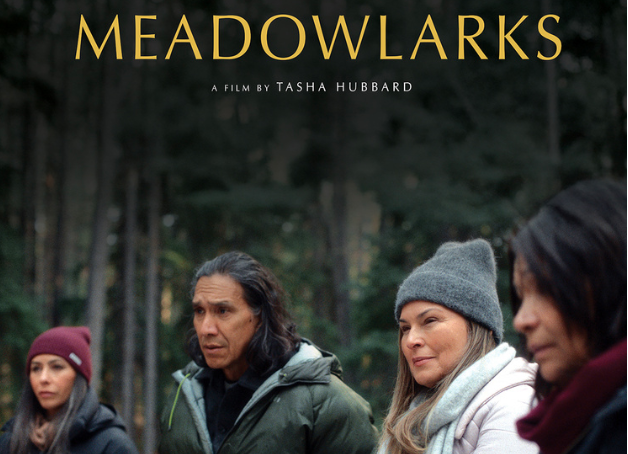
Screening of Meadowlarks
Chatham Capitol Theatre
Inspired by true events, Meadowlarks follows four Cree siblings who were separated as children through Canada’s Sixties Scoop and reunite for the first time as adults. Over the course of a weekend in Banff, they confront their pasts, explore their identities, and begin a journey toward healing, understanding, and family connection. This moving Canadian drama offers a powerful story of resilience, reconciliation, and hope. Sponsored by the Municipality of Chatham-Kent's Diversity, Equity, Inclusion, and Justice team and Chatham-Kent Film Group.
Continue Learning
Can't attend an event in person? There are many ways to learn on September 30 and throughout the year. Listen to Survivors, explore Indigenous voices and perspectives, and deepen your understanding of the history and ongoing impacts of residential institutions and colonization.
E-Learning
Daily Lunch and Learns from the National Centre for Truth & Reconciliation - September 21 - 25, 1:00 - 2:00p.m.
Join daily Lunch and Learn webinars – an immersive experience to UN-learn the myths of colonial history in Canada. Aimed at an adult audience, and open to the public. Hosted virtually over Zoom Webinar and streamed to YouTube. Includes simultaneous English-French, and ASL interpretation. Presented with the gracious support of Enbridge and the Canadian Public Health Association.
Advancing Re(al)conciliation - Free eLearning
RBC is sponsoring an online self-paced course from First Nations University. Anyone in Canada can take this for free.
Listen:
A Day to Listen (September 30th)
Tune in to your favourite local radio station to learn about moving reconciliation forward in meaningful ways. Learn more from the Downie & Wenjack Fund website.
Unreserved
A CBC radio space for Indigenous voices. Host Rosanne Deerchild guides listeners on the path to better understand our shared story. Together, we learn and unlearn, laugh and become gentler in all our relations.
Watch:
Remembering the Children: Live Event Broadcast - September 30, 12:00 p.m.
Watch the national event at Parliament Hill. Watch and learn more on the Truth and Reconciliation Commission website.
Orange Shirt Day
Learn about the origins of Orange Shirt Day through this Youtube video by the Orange Shirt Society.
We Are Still Here and Aftershock Documentaries
Three local women from Aamjiwnaang First Nation in Sarnia, and the Bjekwanong First Nation on Walpole Island, share their memories of surviving residential institutions in this YouTube Video. Then, watch Aftershock, a documentary that features the children of the women in We Are Still Here.
The Secret Path
Animated film adaptation of Gord Downie's album and Jeff Lemire's graphic novel about the life of Chanie Wenjack.
Kevin Lamoureux on Truth and Reconciliation
Kevin Lamoureux, the Associate Vice-President of Indigenous Affairs at the University of Winnipeg, speaks about Truth and Reconciliation at a TEDx event in this YouTube clip.
The Sixties Scoop in Canada
A CBC video on YouTube about how Canada took thousands of Indigenous children from their parents between the 1960s and the 1980s, and how the effects are still being felt today.
Dr. Maureen Lux on the Painful History of Indian hospitals
An APTN video on YouTube about the history of 'Indian' hospitals in Canada.
Read:
Residential Schools Timeline
A visual timeline of residential institutions in Canada. Find it on the Truth and Reconciliation Commission website.
The Witness Blank
Explore items reclaimed from residential institutions, churches, government buildings accompanied by the voices of Survivors. Visit The Witness Blanket website.
The dark history of Canada's Food Guide: How experiments on Indigenous children shaped nutrition policy
A CBC article and recording in which Unreserved host Roseanne Deerchild explores how nutritional studies and experiments were performed in Indigenous communities and residential schools in the 1940s and '50s.
The Truth and Reconciliation Commission's Calls to Action
Drafted from consultations with residential institution survivors and family members across Canada. Recommendations are directed at individuals, organizations, and all levels of government. Read the Calls to Action on the Truth and Reconciliation Commission website.
21 Things You May Not Have Known About the Indian Act
An article from Indigenous Corporate Training Inc. about the Indian Act in Canada.
CK Road to Understanding Indigenous Cultures
Learn about local First Nations, relationships with government, and Treaties. Find the resource on the Living CK website. Hard copies of this resource are available by contacting us.
CK Public Library Resources
Visit the CKPL website to find books and other resources to learn about our shared past and how we can move towards healing, justice, and reconciliation.
-
International Overdose Awareness Day 2026
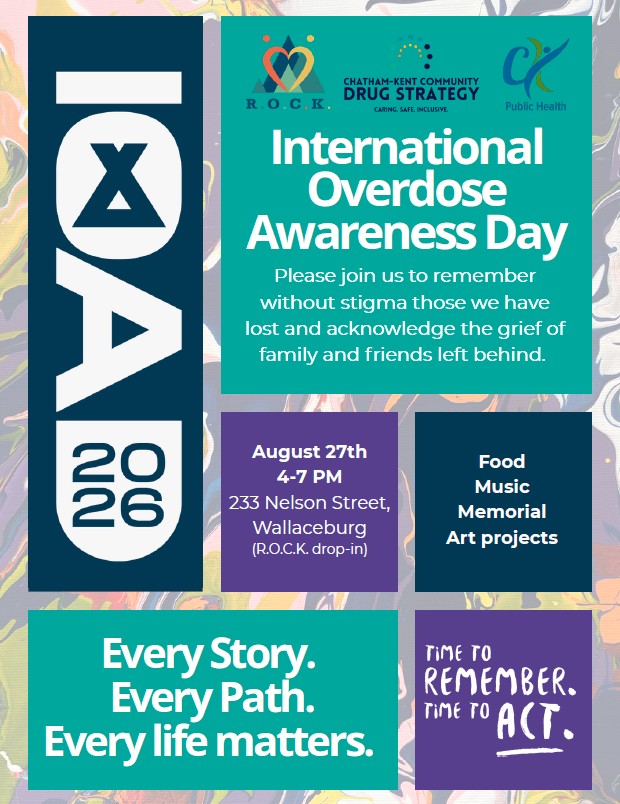
CK Public Health, Reach Out Chatham-Kent, and the Community Drug Strategy invite you to join in honouring International Overdose Awareness Day (IOAD) 2026. Each year in August partners come together to remember individuals whose lives were cut short by preventable drug toxicities, and to re-imagine how we can co-create a safe, caring, and inclusive future for our community. This year, our theme is Every Story. Every Path. Every Life Matters.
Here are some ways you can take action:
- Attend the online learning session on Tuesday August 25th 12-1pm to learn from renowned Nursing Leader, Parent Advocate, and MomsContinue reading
CK Public Health, Reach Out Chatham-Kent, and the Community Drug Strategy invite you to join in honouring International Overdose Awareness Day (IOAD) 2026. Each year in August partners come together to remember individuals whose lives were cut short by preventable drug toxicities, and to re-imagine how we can co-create a safe, caring, and inclusive future for our community. This year, our theme is Every Story. Every Path. Every Life Matters.
Here are some ways you can take action:
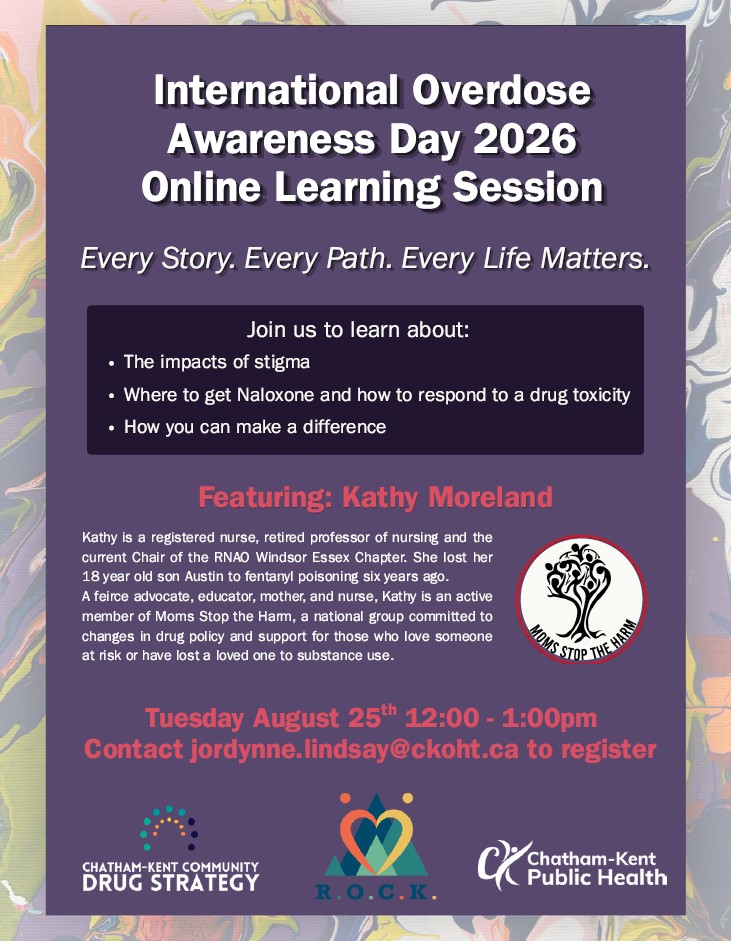
- Attend the online learning session on Tuesday August 25th 12-1pm to learn from renowned Nursing Leader, Parent Advocate, and Moms Stop The Harm Champion, Kathy Moreland. Kathy will share her lived experience journey as a mother who lost her 18-year-old son, Austin, to fentanyl toxicity. Email jordynne.linsday@ckoht.ca to register
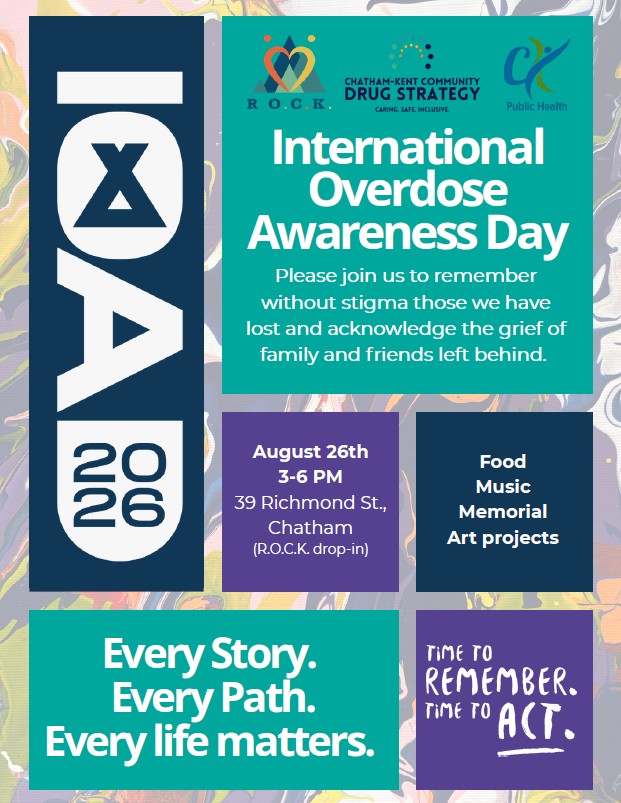
- Attend the in-person memorial gathering on Wednesday August 26th anytime from 3-6pm at 39 Richmond St., Chatham.
- OR drop-in on Thursday August 27th 4-7pm at 233 Nelson St. in Wallaceburg.
- Food and refreshments, music, art, and resources will be provided. All are welcome.
- Use person-first, non-stigmatizing language to support individuals to seek help, provide equitable substance use health services, and encourage unbiased, effective policy. Research shows the words we use shape the care people who use substances receive and the opportunities available to them.
- Carry a Naloxone kit and learn how to respond to an acute drug toxicity.
- Learn more about substance use stigma and drug policy in Canada. Share what you learn with others in your circles.
- Plan a Compassionate Approaches training for your team/organization to learn with and from People With Lived and Living Expertise.
- Advocate for evidence-based solutions to the drug toxicity crisis such as early prevention, voluntary treatment, harm reduction, and supportive housing.
- Wear purple on August 31st to show your support.
-
Aug 14 - 21 2026: Canada's First Mega Mahayagya (Hindu Gathering)
CLOSED: This discussion has concluded.In a historic first, the Bhutanese Nepali Community of Chatham-Kent is hosting the grand Shrimand Bhagwat Saptaha Gyan Mahayagya.
When: August 14 - 21
Where: Everest Convention Centre, 250 National Road, Chatham
This festival serves as a vital bridge to cultural connection, offering the general public a rare immersive window into the rich tapestry of Vedic Sanatan Dharma traditions as global religious leaders converge in Chatham-Kent to share teachings on peace, mutual respect, and community unity.
Volunteers needed.
Grand opening and ceremony Friday, August 15 from 12:00 - 6:00 p.m. Experience a stunning, vibrant cultural procession.
Open to the publicContinue reading
In a historic first, the Bhutanese Nepali Community of Chatham-Kent is hosting the grand Shrimand Bhagwat Saptaha Gyan Mahayagya.
When: August 14 - 21
Where: Everest Convention Centre, 250 National Road, Chatham
This festival serves as a vital bridge to cultural connection, offering the general public a rare immersive window into the rich tapestry of Vedic Sanatan Dharma traditions as global religious leaders converge in Chatham-Kent to share teachings on peace, mutual respect, and community unity.
Volunteers needed.
Grand opening and ceremony Friday, August 15 from 12:00 - 6:00 p.m. Experience a stunning, vibrant cultural procession.
Open to the public daily from 7:30 a.m. to 7:30 p.m.
For more information contact: bnccommunity@gmail.com or 226.971.1461
-
August 1: Emancipation Day & Month
August 1st is Emancipation Day in Canada, and the month of August is Emancipation month in Ontario.
Emancipation Day commemorates the Abolition of Slavery Act, which became law on August 1, 1834, marking the end of the institution of slavery within British colonies, including Canada.
While people often associate chattel slavery with the United States, Canada also has a history of enslavement of People of African descent and Indigenous Peoples. In fact, the first known Black person in Chatham-Kent was enslaved.
A 1793 Act to Limit Slavery in Upper Canada had already prohibited bringing enslaved people intoContinue reading
August 1st is Emancipation Day in Canada, and the month of August is Emancipation month in Ontario.
Emancipation Day commemorates the Abolition of Slavery Act, which became law on August 1, 1834, marking the end of the institution of slavery within British colonies, including Canada.
While people often associate chattel slavery with the United States, Canada also has a history of enslavement of People of African descent and Indigenous Peoples. In fact, the first known Black person in Chatham-Kent was enslaved.
A 1793 Act to Limit Slavery in Upper Canada had already prohibited bringing enslaved people into Upper Canada, however, the 1834 Act went further to lay the pathway to free more than 800 000 people of African descent throughout the British Empire. For most enslaved people, the Abolition of Slavery Act only resulted in partial liberation, freeing children under the age of six while still requiring others to continue serving their former enslavers for four to six years as apprentices. The Act confirmed Canada as a free territory for enslaved African Americans, though, which led to thousands of people of African-descent arriving in Canada from the United States between 1834 and the early 1860s, including in what is now known as Chatham-Kent.
Although the institution of slavery was ended, Black communities continued to experience racism and discrimination in Canada. And no formal apologies or compensation has ever been offered to the people or descendants of those enslaved.
Emancipation Day has been celebrated on or near August 1st each year by Black communities and supporters since 1834. The day was formally recognized in 2008 by Ontario and by Canada in 2021. Ontario also recognized August as Emancipation Month in 2021. Today, Emancipation Day and Month are a time to celebrate the end of slavery, but also to raise awareness about and commit to advancing racial equity.
Activists in Chatham-Kent and Chatham-Kent's Council vocally supported Member of Parliament Majid Jowhari's motion to designate August 1 as Emancipation Day in Canada, including through a formal motion of support sent to local Member of Parliament and all House of Commons representatives.
Local Emancipation Day Events:
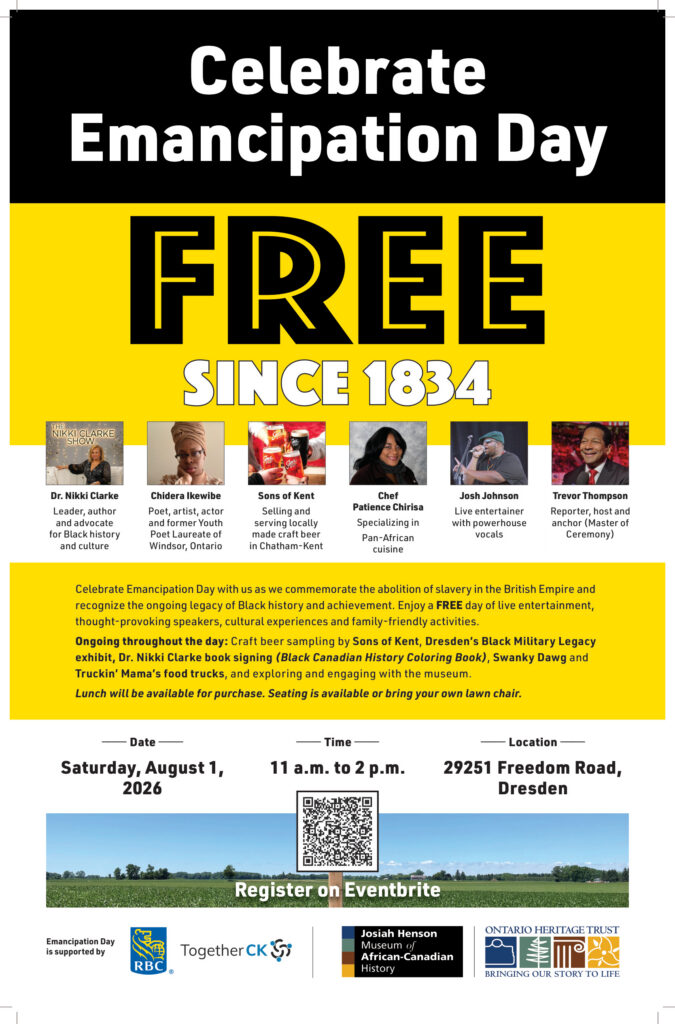
Visit the Josiah Henson Museum of African-Canadian History website for 2026 Emancipation Day events.
Events are free. Registration via EventBrite is encouraged but not required.
August 1, 11:00 a.m. - 2:00 p.m., 29251 Freedom Road, Dresden
Enjoy a program of live entertainment, inspiring speakers, cultural experiences, and family-friendly activities. Lunch available for purchase. Seating is available or bring your own chair.
Learn more:
Buxton National Historic Site & Museum
Chatham-Kent Black Historical Society & Black Mecca Museum
Josiah Henson Museum of African-Canadian History
Chatham-Kent Tourism – Black History
Canadian Museum of Human Rights
-
No. 2 Construction Battalion
 A picture of the No. 2 Construction Battalion, correspondence between Arthur Alexander and the Ministry of Militia & Defence, and the names of Black WWI Veterans from Chatham-Kent is currently on display in the Civic Center lobby.
Have you heard of the No. 2 Construction Battalion?
Thanks to the Buxton National Historic Site & Museum, Chatham-Kent Black Historical Society & Black Mecca Museum, and Ontario Heritage Trust, you can see a photo of the group and the names of local Black WWI Veterans in the Municipality of Chatham-Kent’s Civic Center Lobby.
On July 9th, 2022, the Canadian Minister
Continue readingA picture of the No. 2 Construction Battalion, correspondence between Arthur Alexander and the Ministry of Militia & Defence, and the names of Black WWI Veterans from Chatham-Kent is currently on display in the Civic Center lobby.Have you heard of the No. 2 Construction Battalion?
Thanks to the Buxton National Historic Site & Museum, Chatham-Kent Black Historical Society & Black Mecca Museum, and Ontario Heritage Trust, you can see a photo of the group and the names of local Black WWI Veterans in the Municipality of Chatham-Kent’s Civic Center Lobby.
On July 9th, 2022, the Canadian Minister of National Defence will offer a formal apology to relatives and descendants of members of the Battalion for the racism and discrimination endured by members before, during, and after their service to Canada. To watch the event live, visit: www.no2-cef.ca
The No. 2 Construction Battalion was formed in WWI and served from 1916-1920. It was the largest Black military unit in Canadian history. Although the headquarters for the Battalion were in Nova Scotia, there was a detachment that operated in Windsor and many local Black men were a part of the Battalion.
As they tried t
 Arthur Alexander (pictured) wrote a letter to the Minister of Militia & Defence in 1914 to ask why Black men were not able to enlist in the Canadian militia.o volunteer for the Canadian militia, many Black men were turned away due to prevailing anti-Black racism. Despite the racism they experienced, the men continued to advocate for their participation in War efforts.
 In 1916, the Department of Defence and Militia established a segregated, Black labour Battalion that supported construction and labour needs related to the War. In 1917, the Battalion sailed to England with 595 men, most of whom went on to build and maintain water systems, roads, and railroads and take part in logging for lumber used in trenches, observation posts, bridges, walkways, and even aircrafts.
Despite the anti-Black racism they experienced, the men of the No. 2 Construction Battalion made significant contributions to the War effort. But, these efforts went unrecognized for a long time.
In 1992, the Government of Canada recognized the formation of the No. 2 Construction Battalion as a national historic event and raised a granite monument commemorating the Battalion in Nova Scotia. Canada post issued a commemorative stamp depicting the Battalion in 2016. This weekend, the Ministry of Defence will issue a formal apology to relatives and descendants of members of the No. 2 Battalion for the racism and discrimination they endured.
Stop in at the Municipality of Chatham-Kent's Civic Center and see the picture of the No. 2 Battalion and the names of Black WWI Veterans from Chatham-Kent!
For more information and local Black History, visit the Buxton National Historic Site & Museum, the Chatham-Kent Black Historical Society & Black Mecca Museum, or Ontario Heritage Trust's Historic Site dedicated to Josiah Henson (new name coming soon!).